What do the drone regulations in Norway actually say? (Complete guide 2025)
Rune Millerjord
Photographer (commercial & adventure)
Oct 24, 2025

What do the drone rules in Norway actually say? (Complete guide 2026)
The Civil Aviation Authority's data: 58.4% fly illegally – often without knowing it. Here is everything you need from purchase to certificate. It is much easier than many think.
You have just bought a drone. Now what?
You have just bought a drone, for the same reason as me and 64% of other drone buyers – you want to take great photos and videos. As tools, drones are completely unique, offering perspectives and angles that beat all other equipment.
But then reality hits: laws, regulations, terms like "VLOS", "open category", "operator number". Things that for many in the beginning feel very foreign and not from the photo/video world.
The Civil Aviation Authority's data shows that 58.4% fly illegally (read more about the study here). I do not think people do not care, but the encounter with the "aviation world" is daunting for many. The problem is not the user – the problem is the system.
When I tried to find answers, absolutely basic information seemed almost impossible to find. A simple Google search for "A2 exam" does not give you answers to the most fundamental questions: What do I actually need to fly my drone?, How many questions does the A2 exam have? What does it cost?, Does a drone certificate require a lot of work? Partial information is scattered across four or five different websites, often without clear answers.
We are used to Vipps, Instagram, and Netflix. Systems designed to be intuitive. The first encounter with the "drone" world can for many be anything but intuitive, and that is why this blog was made to make it easier for new drone buyers to know what they need.
In this guide, I want to give you the information you need after buying a drone, up to your first flight with a drone certificate.
"Drone" certificate
A drone certificate gives you the right to fly within a given drone regulatory framework called A1, A3, and A2 in the "open category". This "open category" is a category with relatively low risk. Simply put, it means that flight within this category is assessed to contain low risk. You fly at low altitudes with relatively light drones, which must be visible at all times. The courses you take are simple, but also necessary because it is not risk-free.
PART 1: What EVERYONE with a drone must follow
Regardless of which drone you have, or which certificate you take – these rules ALWAYS apply.
1. Register your drone (mandatory)
If you live in Norway, all drones with a camera must be registered on flydrone.no. This also applies to drones under 250 grams if they have a camera, for example, DJI Mini 4 Pro, DJI Mini 3 Pro, and all other drones in the Mini series. It is the camera that triggers the registration requirement. If you visit Norway with a drone, a different registration path applies, and you can find that further down.
Exception: Drones under 250g without a camera or CE-marked as a toy do not require registration.
The process takes about 10 minutes:
Log in to flydrone.no with BankID
Fill in information about yourself and the drone
Pay NOK 230 (annual fee)
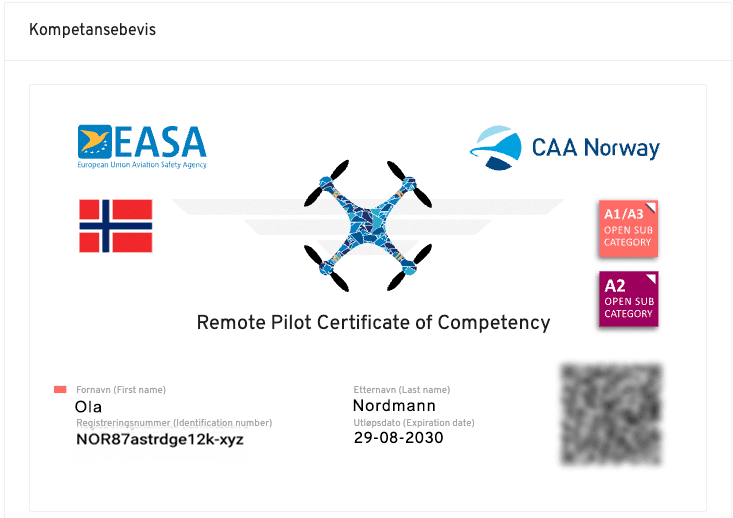
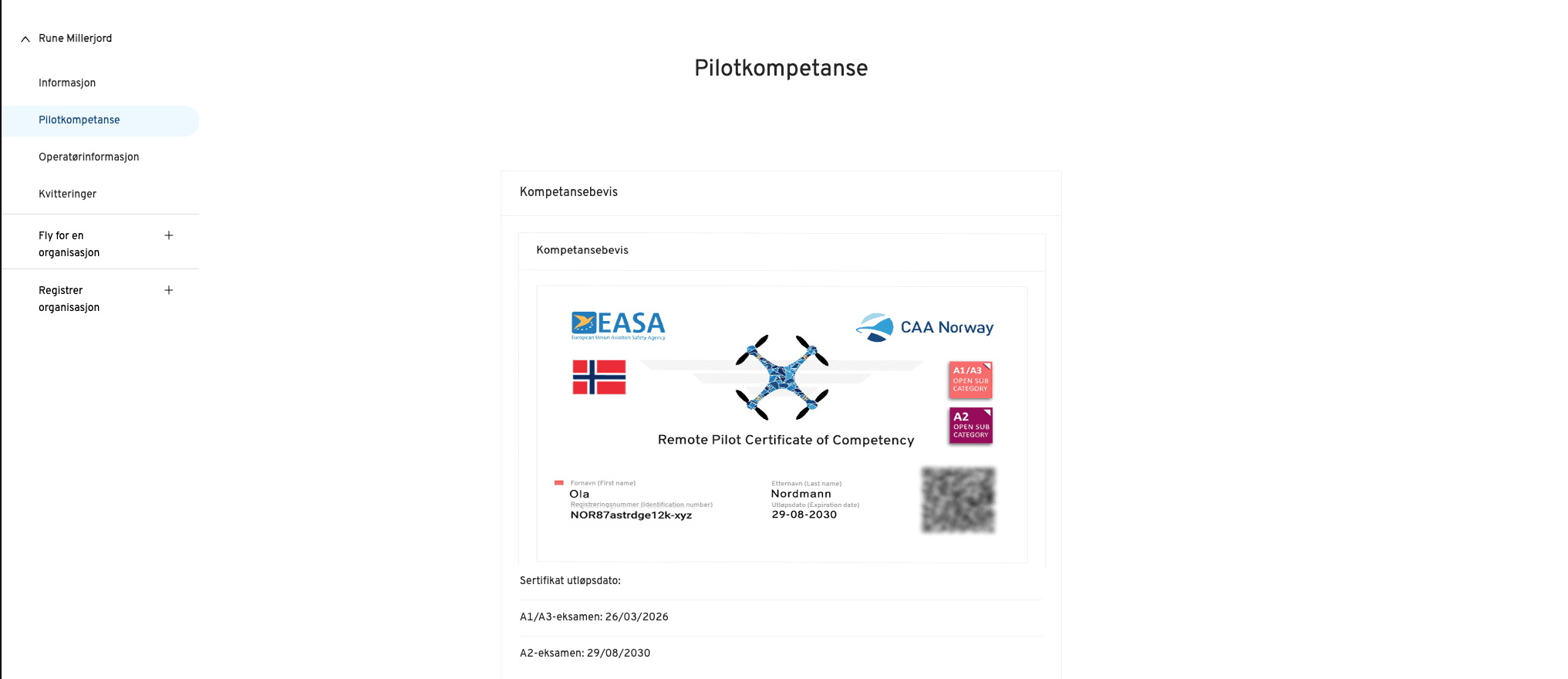
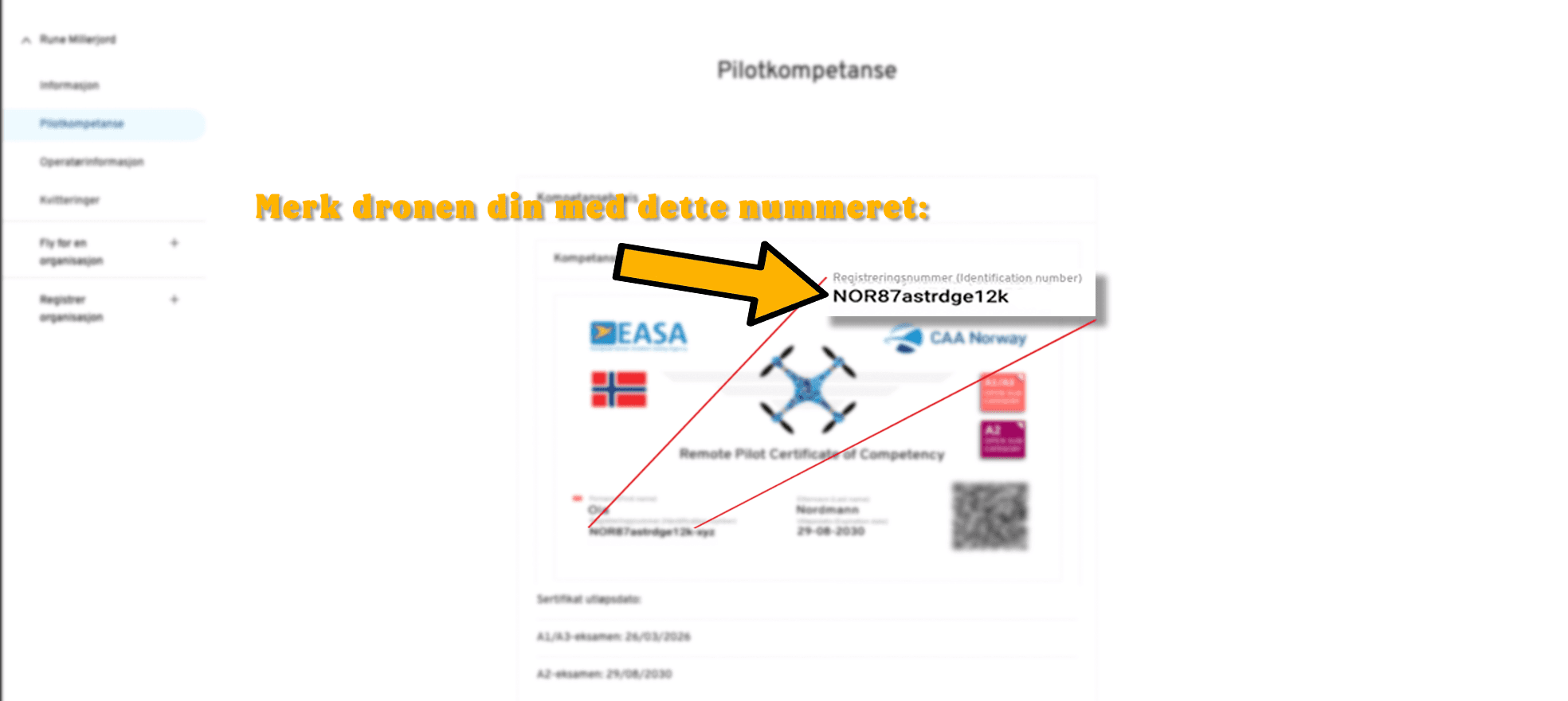
Get operator number (e.g., NOR87astrdge12k-xyz)
Mark the drone with the operator number (label or QR code)
Important: The last digits of the operator number (after the hyphen) are secret and must NOT be marked on the drone.
Screenshot from the "Pilotkompetanse" tab at "Flydrone.no"
Registration if you come as a tourist to Norway
This registration path requires BankID and applies to those living in Norway. If you have an EASA certificate from another EU/EEA country, you do not need to register on flydrone.no at all, as your home country's operator registration also applies here. If you come from the US, UK, Canada, Australia, or other countries outside the EASA system, you must register, but without BankID. I have gathered what applies to you in a separate guide: Fly a drone in Norway as a tourist.
2. Insurance – when is it required?
Drones over 250 grams must be insured (liability insurance). This applies to both hobby and commercial use. The regulations do not distinguish between "commercial", "private" etc. What sets the boundaries for how you can fly is the weight of your drone and your certificates.
Exception: Drones under 250g (like the DJI Mini series) do not need insurance in the open category. But be careful here, because if you equip your drone with an (Intelligent Flight Battery Plus), the drone weighs over 250g, which requires you to fly in the A1 category.
Many home insurance policies cover your drone, but there is a big difference in whether the insurance covers third-party damage. That is to say, whether your insurance also covers damage caused by the drone and not just the drone itself.
Call your insurance company and ask:
Does my home insurance cover drones over 250g?
Does it cover liability damages?
Do I need to upgrade?
3. Maximum flight altitude: 120 meters
Drones must not be flown higher than 120 meters above the ground. This applies to all drones, in all places, with all certificates in the "open category".
Why 120 meters? Because above this altitude, manned aviation (helicopters, light aircraft, etc.) begins to pose a safety risk.
4. VLOS – You must SEE the drone at all times
VLOS stands for "Visual Line of Sight" – you must be able to see the drone with your own eyes at all times. Not through the screen or with binoculars, but it must be visible to you at all times.
5. The 5-kilometer rule near airports
You are not allowed to fly within 5 kilometers of airports without prior permission. This applies to all airports.
How to check:
Use Ninox Drone 2. The old Ninox app is gone, and you must create a new user in the new app. Here is how you do it: How to register and use Ninox Drone 2
Or search on IPPC.no for official airspace maps
6. Check restricted areas before you fly
There are areas in Norway where drone flying is restricted or prohibited:
Restricted areas (R-zones): Central Oslo (R-102) and certain other areas require application and permission
Sensor ban areas: Prohibited to photograph/film certain military and security-critical installations
Conservation areas: Many national parks prohibit drones
How to check:
IPPC.no for airspace restrictions
NSM's drone map for prohibited areas
Ninox Drone 2 for airport zones, but note that the app mainly covers the 5 km zone around airports and shows less than the old app did
SafeToFly.no if you want everything in one map
Four different sources are a lot to keep track of when you just want to know if you can fly where you are standing. I have set up a simpler sequence to do it: Where can I fly a drone in Norway? 3 steps before you take off
7. Checklist before flight (especially important in a new area):
Before you take off:
Check the weather forecast (wind, precipitation, visibility)
Check IPPC.no for NOTAMs (temporary restrictions – firefighting, helicopter operations, etc.)
Check Ninox Drone 2
Check the NSM map for prohibited zones and restricted areas
This list is the short answer. If you want the full version, with what to look for in each step, I have written it out here: Checklist before flying a drone in Norway
PART 2: A1/A3 certificate of competency
Now that you know the basic rules and have registered the drone, you need a certificate of competency to fly legally. But first – let's look at something that might seem confusing.
C-class vs. A-category – two different things
Many mix up these terms, so here is what I found out:
C-class (C0, C1, C2, C3) is marked on your drone. It tells you what kind of drone you have, based on weight and characteristics.
A-category (A1, A2, A3) are operational levels. They tell you how close to people and buildings you are allowed to fly.
The C-class of your drone determines which A-categories you can operate in:
Your drone | C-class | Can fly in | What does it mean? | |
DJI Mini 4 Pro | C0 (under 250g) | A1 and A3 | Can fly over people (not crowds) | |
DJI Air 3 | C1 (250g-900g) | A1 and A3 | Can fly close to people, not over them | |
DJI Mavic 3 Pro | C2 (900g-4kg) | A2 and A3 | Requires A2 certificate |
The table above covers the three most common classes. There are also C3 and C4, and there are some nuances in what each class actually allows. If you want the full picture, it is here: What do C0, C1, C2, C3 mean on your drone?
Who needs an A1/A3 certificate of competency?
You need an A1/A3 certificate of competency if you are going to fly a drone with C1 marking (250g-900g). For C0 drones under 250g, it is not required, but I recommend the course anyway – it provides a good and simple introduction to safe drone flying.
How to get an A1/A3 certificate of competency
You can take the course for free on flydrone.no after you have registered as a drone operator.
The course contains:
Videos and text about airspace, safety, VLOS, and technical knowledge
40 questions on the exam (you can take from 30 minutes to 12 hours)
Must get 75% correct (30 out of 40) to pass
Can be retaken for free if you fail
Time investment: 2-3 hours in total (course + exam).
What does the A1/A3 certificate of competency allow you to do?
With an A1/A3 certificate of competency, you can:
In A1 category (close to people):
Fly C0 drones over people (but not over crowds)
Fly C1 drones close to people, but not intentionally over them
In A3 category (open areas):
Fly all C-marked drones at least 150 meters away from residential, commercial, industrial, and recreational areas
For most hobby pilots with a DJI Mini or Air series, the A1/A3 certificate of competency is all you need. If you are one of those who envision that you might want to make some money from your drone, read this blog post: 4 reasons why the A2 license pays off.
A2 certificate: The solution for those of us with a drone over 900g
About 13.6% of Norwegian drone pilots take the A2 exam. Because they need 5m/30m instead of being limited to 150 meters. This makes a significant difference when it comes to opportunities for better photos or videos when flying the "DJI Mavic" series.
With an A2 certificate, you can:
Fly 30 meters from people (standard mode)
Fly 5 meters from people (in slow speed mode)
Fly in areas where people actually move around
Document events and activities
Greater opportunity to make some money from your drone (many clients expect A2)
What is an A2 certificate?
A2 is a step up from A1/A3. It requires a bit more knowledge, but gives dramatically more freedom for those of us with a slightly heavier drone. The A2 certificate gives you the opportunity to fly 5m from people with a C2-marked drone (in slow mode) and 30m from people without slow mode. Since these drones (e.g., DJI Mavic Pro series) have better video and photo capabilities, this opens up opportunities and a market that, for my part, came as a big surprise. I have earned back this investment many times over, and the drone was originally bought with the intention of taking photos and videos for my own sake (hobby).
When you take the A2 certificate:
Meteorology (weather and wind)
Airspace (better understanding)
Technical knowledge (how the drone works)
Risk assessment (safety before, during, after flight)
The process for an A2 certificate:
Take the mandatory A2 online course (flydrone.no) – free
Prepare for the exam (1 week) – use the DroneKlar app or self-study
Book exam at a driver licensing office – 30 questions, 60 min, 23 correct to pass (read more about the A2 theory test)
Practical self-training – you train yourself, no examiner (free checklist here)
Download certificate from flydrone.no
Cost:
Exam: ~NOK 1,400
Preparation: NOK 0-599
Total: under NOK 2,500
→ Read more about what the A2 certificate costs
Read complete A2 guide → How to pass the A2 drone exam (2025)
Who should take A2?
If you answer yes to any of these:
You do not rule out getting paid for drone work (real estate, events, tourism)
You often fly where people move around
150 meters feels too restricted when you have invested in a good drone over 900g
For me, the choice was simple – 150 meters did not work in practice. A2 opened the doors to the type of photos and videos I actually wanted to make, and many commercial actors expect you to have an A2 certificate. The "DJI Mini" series are very good drones, but the difference up to the "Mavic Pro" series is a lot bigger than many think when it comes to the quality of photos and videos.
Good luck with drone flying. You can do this.
Updated: July 2026