What do C0, C1, C2, C3 mean on your drone? (and where can you fly)

Rune Millerjord
Photographer (Commercial & Adventure)
Nov 23, 2025
What do C0, C1, C2, C3 mean for your drone? (and where can you fly)
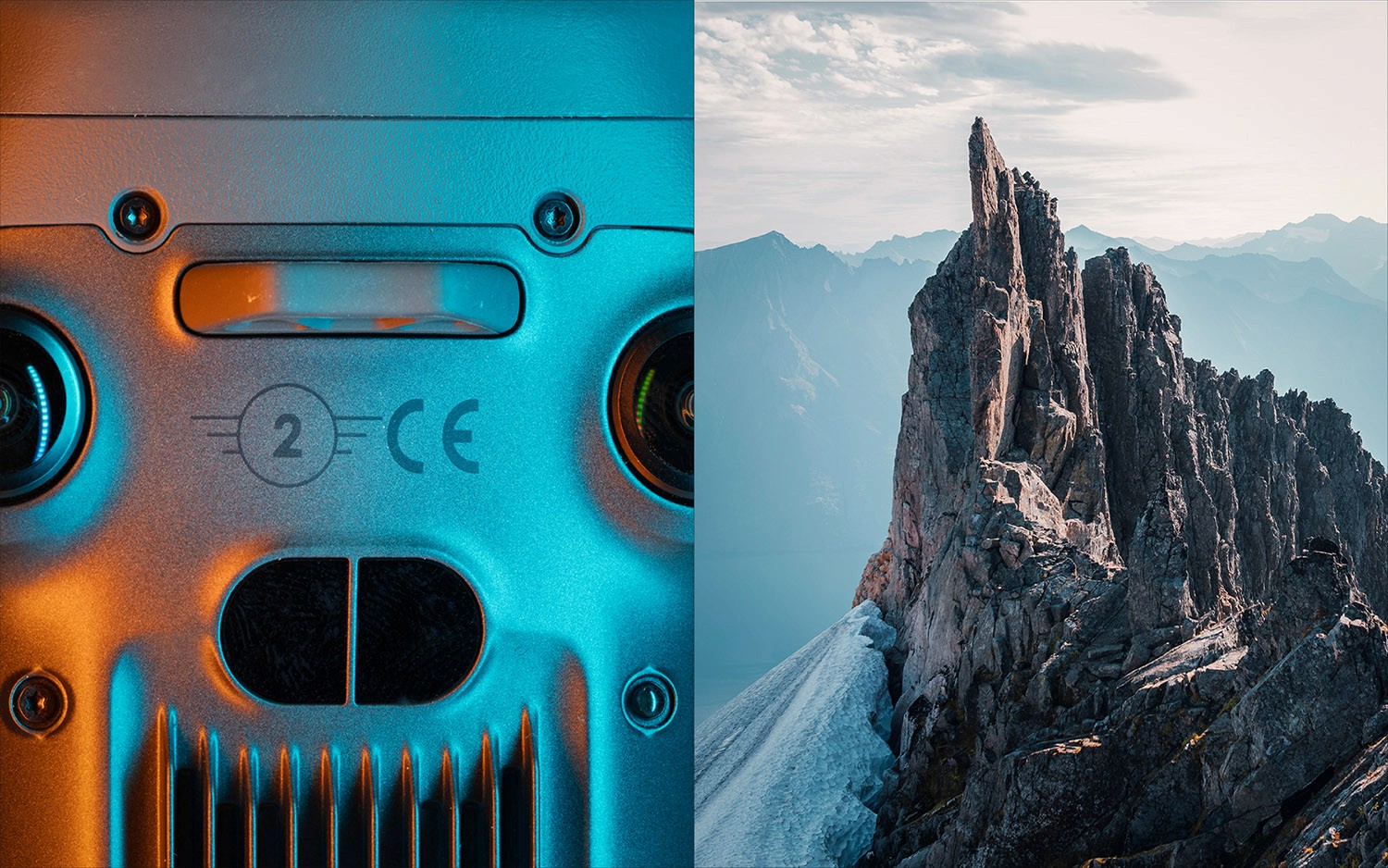
Many wonder what the C-marking on the drone actually means. On the underside of the drone, you will find a C0, C1, C2, or C3 label, but what does this mean and why is it important for what it tells you about where you can fly?
In short: The C-number determines how close you are allowed to operate the drone to people and buildings. A C0 drone can fly closer to people than a C2 drone. A C3 drone must maintain a good distance from buildings. But the details are more nuanced than that.
In this guide, we will go through what C-class means, explain which drones fall under each category, and most importantly: what it means in practice when you are going to fly. After reading this, you will know exactly what the C-marking on your drone allows.
What is C-marking?
C-marking is the EU's classification system for drones. The system became mandatory on January 1, 2024, and divides drones into five classes: C0, C1, C2, C3, and C4.
Why is this important for you? Because the C-class determines which flight rules apply. When you fly a drone in Norway, you operate in what is called the "open category" – and this category is divided into three sub-levels: A1, A2, and A3. Each of these has different rules for how close you can fly to people and buildings.
The C-marking on your drone sets the boundaries for which of these sub-levels you can use. A C0 drone can be used in both A1 and A3, while a C2 drone can only be used in A2 and A3. This practically determines how flexible you are when you fly.
CE vs C-marking – what is the difference?
Many confuse CE-marking with C-marking, but they mean different things:
CE-marking is general product safety that applies to all electronic products sold in the EU. This only tells that the product meets basic safety requirements.
C-marking (CIL) is specific to drones and directly connects to flight rules. This is the marking that actually determines where you can operate your drone.
When checking your drone, it is the C-marking (C0, C1, C2, etc.) you should look for – not just the CE marking.
C-marking and A-categories – how do they relate?
The C-marking on your drone determines which A-categories you can fly in. But what is really an A-category?
The A-categories (A1, A2, A3) are the three "operational levels" within the open category. They define how close you are allowed to fly to people and buildings:
A1: Fly close to people. C0 drones can also fly over people (not crowds), while C1 drones cannot deliberately fly over people.
A2: Fly at least 30 meters from people (or 5 meters in slow mode). Requires A2 certificate and C2 drone.
A3: Fly at least 150 meters from buildings, industrial areas, and recreational areas. All C-marked drones can fly in A3.
The connection between classes and categories explained: C0 and C1 provide access to A1 and A3. C2 provides access to A2 and A3 (with A2 certificate). C3 can only fly in A3. The C-marking sets the boundaries for which A-categories you can operate in – and thus how flexible you are when you fly.
The connection: C-class → A-category → Practical use
C-class | Can be used in | What does it mean practically? | Example (weight) |
C0 | A1 + A3 | Fly over people (not crowds) | DJI Neo (135g), DJI Flip (<249g), DJI Mini 4 Pro (<249g) |
C1 | A1 + A3 | Fly close to people, not deliberately over them | DJI Air 3 (720g), DJI Mavic 3 Classic (~900g)* |
C2 | A2 + A3 | Min. 5m/30m from people (with A2 certificate) | DJI Mavic 3 Pro (958g), DJI Mavic 4 Pro (1063g) |
C3 | A3 | Min. 150m from buildings | DJI Inspire 3 (~4000g) |
*DJI Mavic 3 Classic can be upgraded to C1 via firmware update.
Short explanation:
C0 drones like DJI Neo and Flip are perfect for beginners and require minimal certification. They can fly closer to people, but they weigh under 250g, making them less stable in the wind.
C1 drones like DJI Air 3 provide better stability and camera quality, but require A1/A3 online course. They can fly close to people, but not directly over them.
C2 drones like DJI Mavic 3 and 4 Pro require A2 examination, but open up for professional use with the ability to fly 30 meters from people (or 5 meters in slow mode). This is the "standard" for commercial drone use.
C3 drones like DJI Inspire 3 are professional systems for filming and inspection, but must maintain 150 meters from buildings, and many see that drones like "DJI Mavic 4 Pro" can now handle the tasks that were previously done with the Inspire series.
C-classes explained
C0: Drones under 250 grams
C0 drones weigh less than 250 grams and have a maximum speed of 19 m/s. The most important thing about C0 is that you can fly over people – but not over crowds. This makes them ideal for hobby use and one could argue that this is the C-class with the least risk.
If the drone has a camera, you must register as an operator with the Norwegian Civil Aviation Authority. It costs nothing and takes five minutes. You do not need an exam to fly C0 drones, but you must follow basic flight rules such as a maximum altitude of 120 meters.
Examples: DJI Neo (135g), DJI Flip (<249g), DJI Mini 4 Pro (249g), DJI Mini 3 Pro (249g)
The advantage of C0 is easy access and minimal regulation. The disadvantage is that low weight makes them more susceptible to wind, and camera quality is usually worse than on heavier drones.
C1: Drones under 900 grams
C1 drones weigh between 250 and 900 grams. They must have Remote ID (sending position to authorities) and geo-awareness (alerts about no-fly zones). You can fly close to people, but not deliberately over them. This gives you more flexibility than maintaining 150 meters away from buildings.
To fly C1, you need an A1/A3 certificate. This is a free online course with the Norwegian Civil Aviation Authority that takes 1-2 hours. You complete a simple multiple-choice test at the end.
Examples: DJI Air 3 (720g), DJI Air 3S (724g), DJI Mavic 3 Classic (~900g)
C1 provides you with better stability in the wind than C0, while you still do not need an A2 examination at the traffic station. Camera quality is significantly better than on C0 drones, but you must still keep a distance from people. My thought is that this becomes a "sweet" spot for hobby use and better image quality.
C2: Drones under 4 kg
C2 drones weigh between 900 grams and 4 kg. They must have slow mode which limits speed to 3 m/s. With an A2 certificate, you can fly 30 meters from people in normal mode, or 5 meters in slow mode. This is a dramatic leap from the 150-meter rule.
You must take the A2 exam at a traffic station. The exam costs around 1000 NOK and takes 60 minutes with 30 multiple-choice questions. You need 23 correct answers to pass.
Examples: DJI Mavic 3 Pro (958g), DJI Mavic 4 Pro (1063g), DJI Matrice 30
C2 is the "gateway" for professional use because the 5/30-meter rule makes urban missions practically possible. The interesting thing here is that the image and video quality becomes significantly better, the drone is more expensive, but there are also MUCH fewer people flying in A2. If you are like me and are interested in photography and video, and you have had this as a hobby for a few years, the competition in this market is quite different than with traditional photography/video. Taking the A2 exam was easier than I thought and the opportunity to make some money or get back your investment considering that you buy a C2 drone was surprisingly quickly done. The investment was returned within days alongside a full-time job. Please feel free to reach out if you have the same experience! If you want to charge for real estate photography, inspections, or commercial filming, many serious clients expect an A2 certificate. The 5-meter rule in slow mode also provides even more flexibility for close-ups of people and buildings.
C3 and C4: Drones under 25 kg
C3 and C4 drones can weigh up to 25 kg but must fly in the A3 category. This means 150 meters from buildings, industrial areas, and recreational areas. In practice, this makes them useless for urban work without special permits.
C3 are larger drones for special uses such as agriculture, inspection of power lines, or filming in the mountains. C4 are model airplanes without automation – that is, planes you control manually without GPS or autopilot.
For most Norwegian drone pilots, C3/C4 is not relevant. If you need helicopter-sized drones, you are probably already working with specialized systems and know what you need.
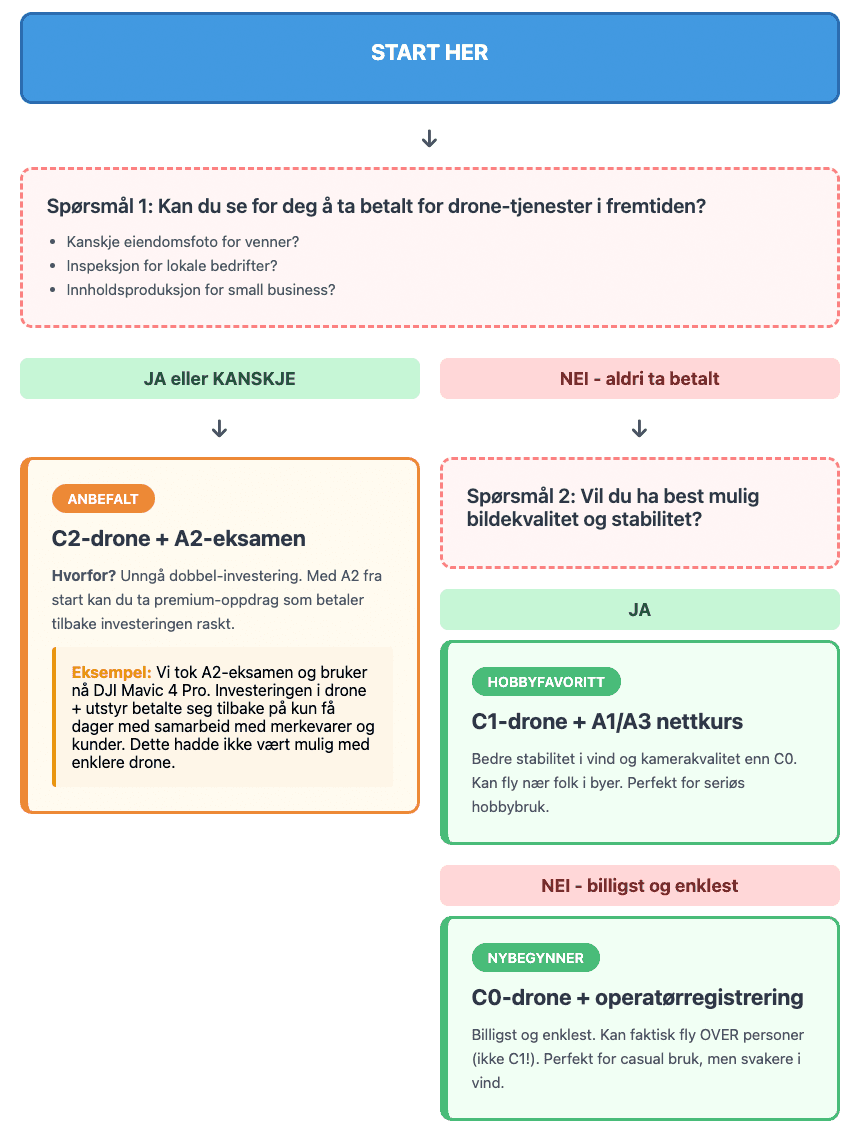
Practical decision table: "What do you want to do with the drone?"
Unsure which C-class you need? Follow this flowchart to find the right drone and certificate based on how you plan to use the drone:
Buying Guide 2025
Before you buy a drone, check the C-marking. You will find it physically on the drone (usually on the underside) or in the product specifications from the manufacturer.
Checklist before purchase:
✓ Is the drone C-marked?
✓ Which A-category do I need?
✓ Do I have the correct certificate?
✓ Am I thinking of charging at some point? → Choose C2
Summary
The C-marking on your drone determines which A-category you can fly in, and thus how close you are allowed to operate to people and buildings. C0 and C1 work well for hobby use, but if you ever want to charge for photo/video or work you can do with your drone, consider a C2 drone and taking an A2 certificate.
Drones without C-marking (legacy drones) are heavily restricted from January 1, 2024. They must fly in the A3 category (150m from buildings), making them impractical for most purposes. Always buy a C-marked drone for maximum flexibility.
Remember: The C-number is not just a label – it is the key to where you can actually fly.
Good luck with your drone choice. If you are considering the A2 certificate, check our complete guide here.